
Tinnitus Trigger Tracker
Tinnitus rarely stays the same from week to week. Score how your tinnitus affects you, log it over time, and compare your trend against what changed — sleep, stress, noise exposure, caffeine, or a new sound-therapy routine.
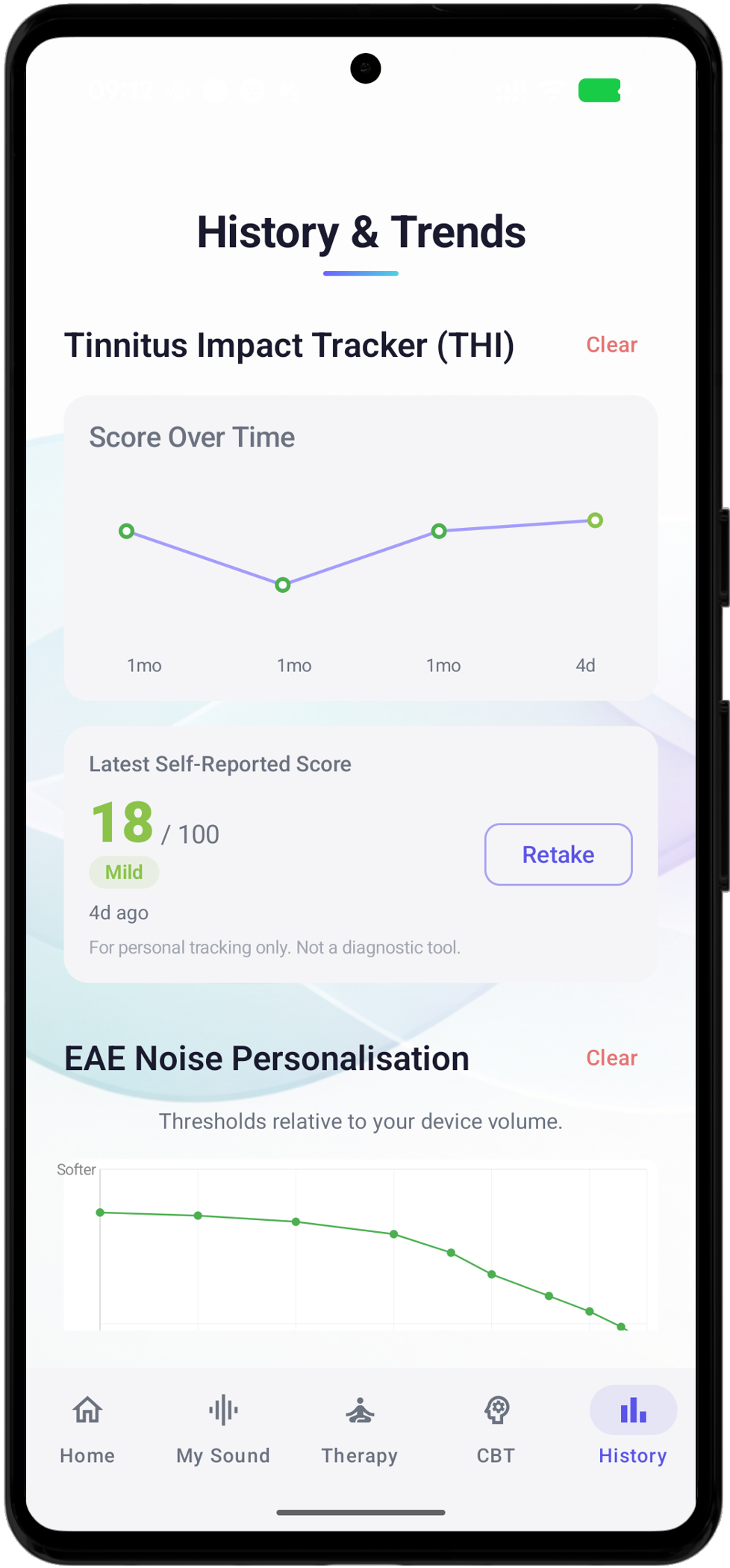
How tracking works in Tinnitus Toolkit
- Score your tinnitus impact. The app uses the Tinnitus Handicap Inventory (THI), a widely used self-assessment questionnaire from the clinical literature, to turn "how bad is it lately?" into a number you can compare across weeks.
- Build your history. Each completed questionnaire is stored on your device and plotted as a trend, alongside your saved tinnitus sound profiles — so a shift in your score sits next to a record of what your tinnitus sounded like at the time.
- Connect the dots. When your trend moves, look at what changed: poor sleep, a loud weekend, a stressful stretch, starting or stopping a sound tool. Patterns that are invisible day-to-day often become obvious over a month of data points.
Why track instead of guess?
Tinnitus perception is strongly influenced by attention and mood, which makes memory an unreliable guide — a bad day feels like a bad month. A recorded score removes that distortion. Tracking is also how you evaluate whether anything you're trying is helping: without a baseline and a follow-up, there's no way to tell improvement from wishful thinking. The same principle is used in clinical research, where THI change over time is a standard outcome measure.
Honest limits
The THI is a validated self-report questionnaire, but a score in an app is not a diagnosis, and a trend is not proof of cause and effect — noticing that your score worsens after loud events is a useful personal observation, not a clinical finding. Tinnitus Toolkit is not a medical device. If your tinnitus changes suddenly, becomes one-sided or pulsatile, or is accompanied by hearing loss or dizziness, see a doctor or audiologist.
Private by design
- All scores stay on your device — no account, no cloud, no data collection
- Works fully offline
- Free to use, with a 7-day trial of the full toolkit
Frequently Asked Questions
About tracking your tinnitus.