
Tinnitus Frequency Finder
Tinnitus can sound like a whistle, ring, hiss or narrow band of noise. Estimating its pitch gives you a useful starting point for personalised sound tools.
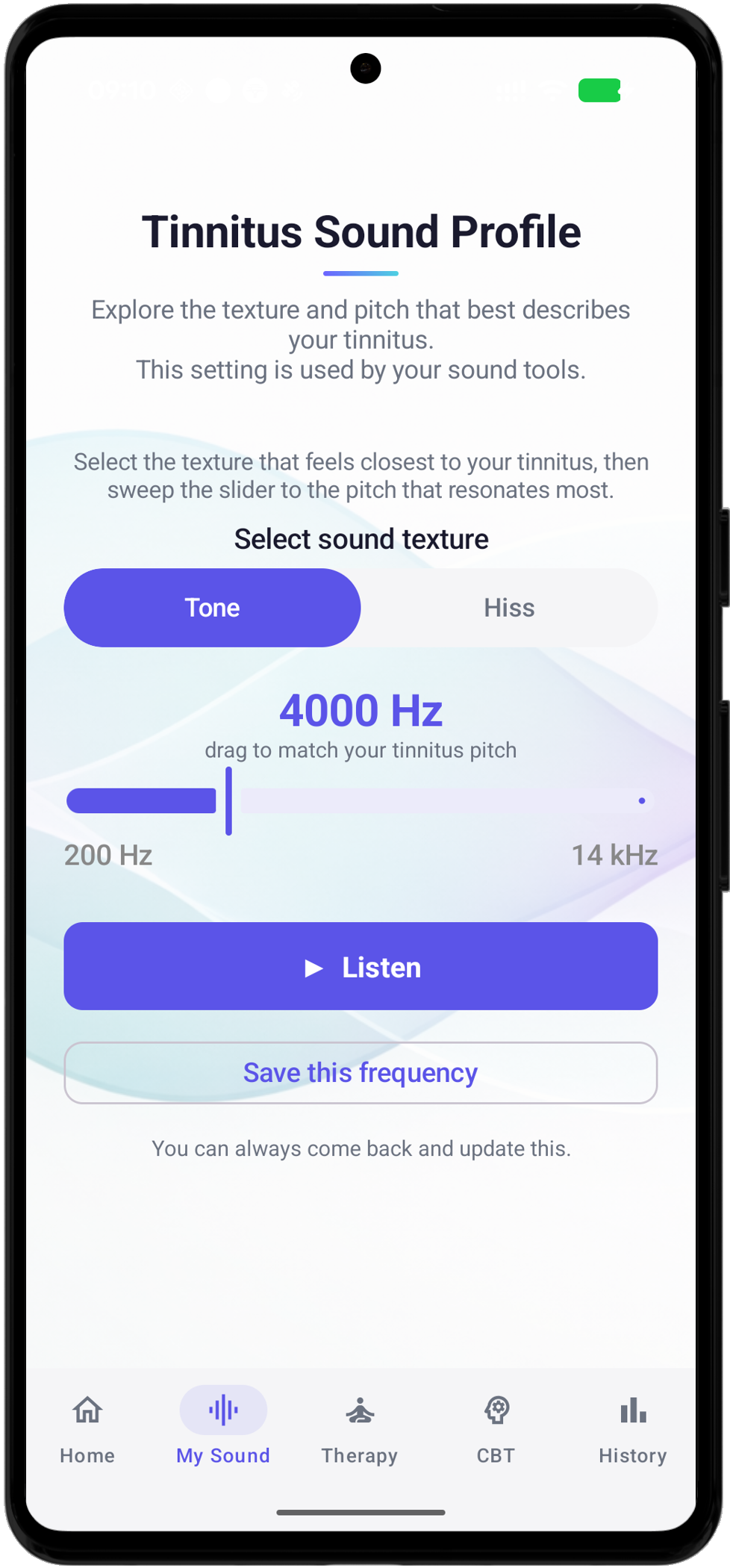
Estimate first. Refine later.
Our free browser-based Tinnitus Simulator lets you explore several common tinnitus sound types and estimate the general frequency region you hear without installing anything.
Tinnitus Toolkit then lets you refine that estimate using both tone and hiss matching, adjust from 200 Hz to 16 kHz, save your tinnitus sound profile and use it with the app’s personalised sound therapies.
Both tools provide an approximate personal estimate, not a clinical measurement or hearing test.How the app frequency finder works
- Choose the texture. Tinnitus that sounds like ringing or whistling may be easier to match with a pure tone. Static-like or “shhh” tinnitus may be closer to a hiss, which is a narrow band of noise centred on a frequency.
- Sweep through the pitch range. Drag the slider while the sound plays and settle on the frequency that feels closest to what you hear. There are no forced choices and no automated sequence: you control the sound directly.
- Save a working estimate. Your match becomes part of your tinnitus sound profile and is used by the app's frequency-based sound tools. You can return and refine it whenever your perception changes.
Why estimate your tinnitus frequency?
Some sound-based approaches studied in tinnitus research are organised around an individual's perceived tinnitus pitch. Band-gap sound removes energy near the selected frequency, while flanking-band sound places two bands of noise on either side of it.
A frequency estimate allows these sounds to be personalised. Tinnitus Toolkit also includes EAE noise shaped by an optional listening calibration, structured CBT and CBT-I content, progress tracking and a monthly research digest.
An estimate, not an exact measurement
Tinnitus pitch matching is approximate. The perceived sound may shift with time, fatigue, stress or recent noise exposure, and many people hear a band of frequencies rather than one precise tone.
Treat your result as a useful working estimate rather than a fixed measurement. Neither the browser simulator nor the app frequency finder is a hearing test, and they cannot assess hearing loss or diagnose a medical condition.
Private by design
- No account or sign-up required
- Your tinnitus sound profile stays on your device
- No advertising or third-party analytics
- The app's core tools work offline
- Seven-day trial of the complete toolkit
Ready to refine your match?
Use tone or hiss matching in Tinnitus Toolkit, save your frequency and carry it directly into the app's personalised sound therapies.
Get Tinnitus Toolkit on Google PlayFrequently Asked Questions
About estimating and matching tinnitus frequency.